Coordinating Packet Prioritization Protocols to Maintain Fluidity Across Variable Networks in Team-Based Game Streams
Clara Brooks · Jun 26, 2026
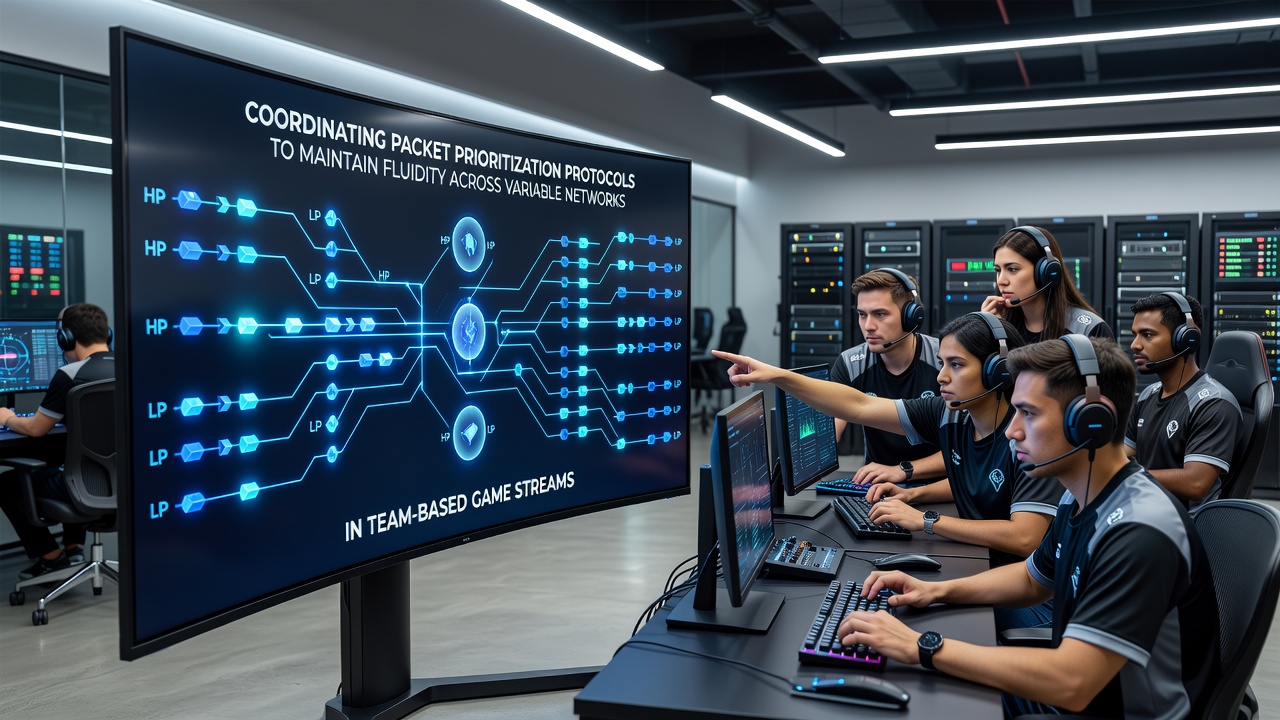
Coordinating Packet Prioritization Protocols to Maintain Fluidity Across Variable Networks in Team-Based Game Streams
Observers note that team-based game streams demand precise coordination of packet prioritization protocols because network conditions shift constantly during live competitive sessions. Data from industry reports indicate that multiplayer titles generate mixed traffic types including real-time game state updates, voice communications, and video encoding streams, each requiring distinct handling to prevent disruptions. Experts at research institutions have documented how protocols such as Differentiated Services Code Point marking and Resource Reservation Protocol extensions assign higher precedence to latency-sensitive packets while deprioritizing bulk data transfers.Core Mechanisms Behind Packet Coordination
Engineers implement classification engines that inspect packet headers at edge routers and assign traffic classes based on application requirements, and this process integrates with queuing disciplines like Weighted Fair Queuing to allocate bandwidth dynamically. Research indicates that in environments where bandwidth fluctuates, such as during peak tournament hours, these mechanisms reduce jitter by ensuring game-critical UDP packets traverse congested links ahead of lower-priority streams. Those who manage large-scale esports infrastructures often combine these approaches with traffic shaping policies that limit burst rates, which prevents buffer overflows and maintains consistent delivery intervals across variable paths.
Adaptation Strategies for Network Variability
Variable networks introduce packet loss and reordering that challenge stream continuity, yet prioritization frameworks counter these issues through adaptive algorithms that monitor round-trip times and adjust marking thresholds in real time. Studies conducted by academic groups in North America reveal that integrating feedback loops from client-side telemetry allows servers to reclassify traffic when congestion signals appear, and this technique has proven effective in cross-regional relays where latency spikes occur unpredictably. Observers highlight cases where teams competing in international events rely on such coordination to sustain frame delivery rates above 120 frames per second even when intermediate links experience 15 percent packet loss.

Integration with Modern Streaming Architectures
Platform operators embed these protocols within content delivery networks that support both traditional broadcast and emerging peer-assisted distribution models, and the combination enables seamless scaling during events that attract thousands of concurrent viewers. In June 2026, updates to transport layer standards are expected to introduce enhanced support for multipath routing, allowing packets to traverse multiple network interfaces simultaneously while preserving priority ordering. Data compiled by European telecommunications bodies shows that such enhancements lower average end-to-end delay by measurable margins in high-density urban deployments where last-mile variability remains a persistent factor.
Practical Implementations Across Regions
Teams operating in Asia-Pacific markets frequently deploy custom extensions to existing protocols that account for regional peering arrangements, and these adjustments ensure that team coordination channels receive protected status during intense match phases. Meanwhile, North American service providers have adopted measurement frameworks developed through collaborations between universities and industry consortia, yielding datasets that quantify the impact of prioritization on perceived stream quality. A report accessible via ENISA network resilience studies outlines how similar techniques mitigate risks associated with fluctuating international routes, while additional findings from Australian communications research emphasize the value of proactive marking in mobile network environments.
Challenges and Measurement Approaches
Accurate measurement remains essential because misconfigured priorities can inadvertently starve secondary streams such as spectator overlays or post-match analysis feeds. Researchers employ active probing combined with passive flow analysis to validate that high-priority classes achieve target latency bounds, and these methods generate statistics that inform iterative protocol refinements. Those managing tournament infrastructure report that continuous monitoring dashboards reveal patterns in traffic behavior that static configurations often overlook, prompting dynamic policy updates during live events.
Conclusion
Coordinating packet prioritization protocols delivers measurable improvements in stream fluidity when networks vary in capacity and reliability. Evidence from multiple regions demonstrates that systematic classification, adaptive queuing, and regional tuning collectively support the demanding requirements of team-based game broadcasts. Continued evolution of these techniques alongside emerging standards positions the field to handle increasing scale and complexity without compromising delivery consistency.