Regional Infrastructure Variances That Shape Bitrate Adaptations During Extended Portable Device Transmissions Across Emerging Gaming Services
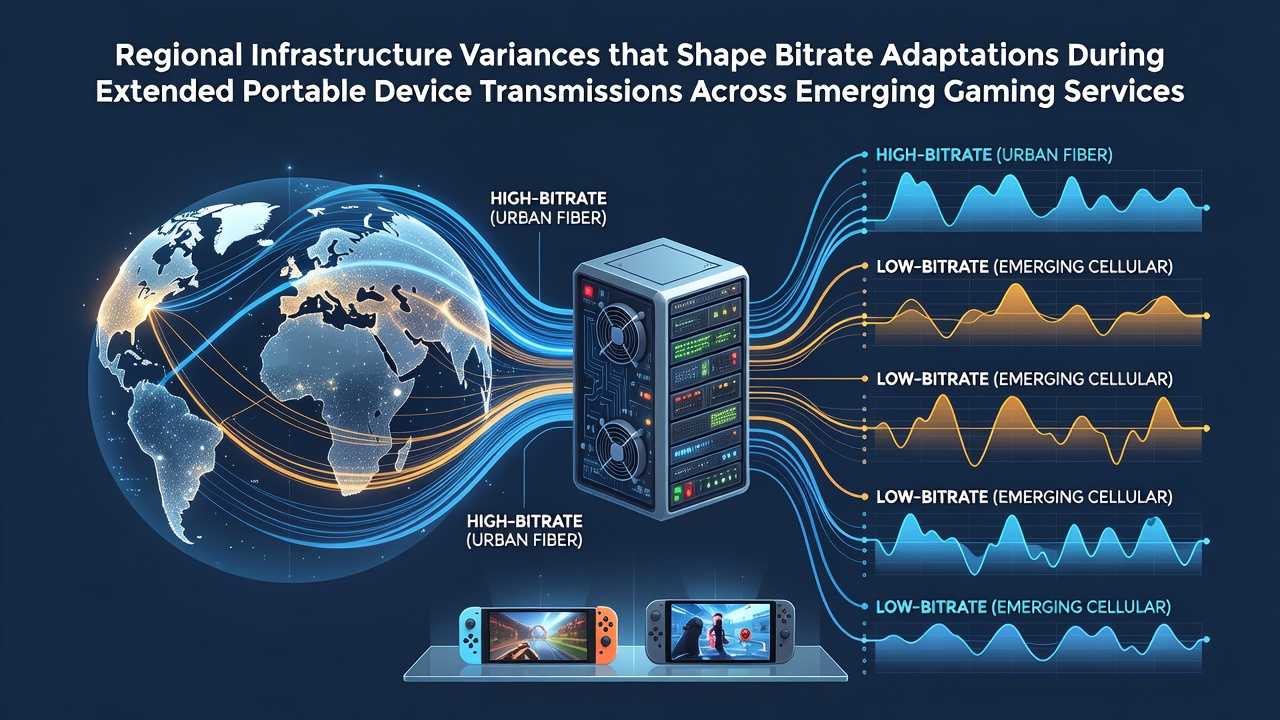
Regional differences in network infrastructure continue to influence how emerging gaming services adjust bitrate during prolonged sessions on portable devices, and data from multiple markets shows that fiber density, 5G rollout speed, and spectrum allocation create distinct adaptation patterns. Observers note that portable transmissions in cloud gaming environments rely on real-time bitrate scaling to maintain stability when users remain connected for hours at a time, while underlying infrastructure determines the range of adjustments available to service providers.
Infrastructure Foundations Across Major Regions
North American networks feature widespread cable and fiber deployments in urban corridors, yet rural zones often depend on fixed wireless or satellite links that limit sustained upload capacity during extended gameplay. European markets demonstrate denser fiber penetration in several member states, although regulatory variations between countries produce uneven 5G mid-band availability that affects how services modulate bitrate when devices move between cells. Asian infrastructure presents a different profile where dense urban 5G coverage in countries such as South Korea and Japan supports higher baseline bitrates, whereas emerging deployments in Southeast Asia encounter more variable backhaul quality that forces more frequent downward adjustments during long sessions.
Researchers tracking transmission metrics report that these regional baselines shape the algorithms used by gaming platforms to predict and respond to congestion, and figures from 2025 deployments indicate that services operating across borders must maintain separate adaptation profiles for each market. As of July 2026, ongoing spectrum auctions in multiple regions continue to alter available capacity, which in turn modifies the thresholds at which portable devices trigger bitrate reductions to preserve session continuity.
Bitrate Adaptation Mechanisms in Portable Contexts
Cloud gaming services employ adaptive bitrate techniques that monitor packet loss, latency, and throughput on portable hardware, then scale encoding parameters accordingly during transmissions that may last several hours. Devices equipped with newer chipsets can sustain higher initial bitrates when connected to robust regional networks, yet the same hardware shifts to lower profiles when infrastructure constraints appear, such as limited mid-band spectrum or congested backhaul routes. Studies of session data reveal that adaptation logic often incorporates regional maps of expected performance, allowing services to preload conservative settings in areas known for higher variability.
Long-duration transmissions introduce additional variables because portable batteries and thermal limits interact with network demands, prompting services to incorporate device-state feedback into bitrate decisions. One analysis of cross-continent gameplay logs showed that sessions exceeding ninety minutes triggered more aggressive scaling in regions with lower average cell density, whereas markets with extensive small-cell deployments maintained steadier rates. Service providers therefore calibrate their adaptation engines to regional norms rather than applying uniform global rules.
Transmission Patterns Observed in Emerging Services
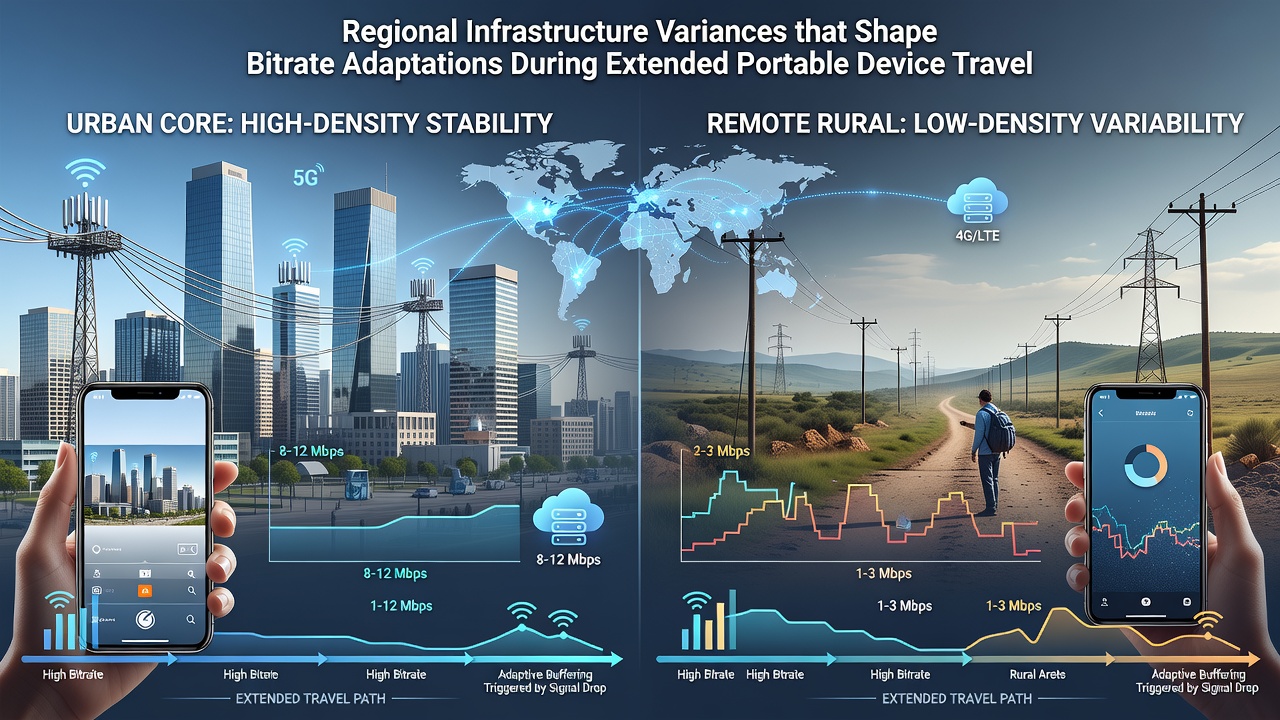
Emerging gaming platforms launched after 2024 have integrated region-specific bitrate ladders that account for both fixed infrastructure and mobile spectrum characteristics. In markets where 5G standalone cores are fully operational, services can offer higher sustained bitrates for portable users because handoff latency remains low even during extended movement. Conversely, regions still transitioning from 4G cores experience more frequent bitrate drops when devices cross coverage boundaries, and session telemetry confirms these patterns persist across multiple service tiers.
Data collected from multi-hour portable sessions indicates that adaptation frequency rises sharply in areas where backhaul capacity lags behind access network speeds, forcing encoders to reduce quality to match the weakest segment of the path. Government broadband reports from the United States and from the Australian Communications and Media Authority document similar disparities between metropolitan and regional zones, illustrating how infrastructure gaps translate directly into bitrate behavior during gameplay. Providers respond by maintaining parallel encoding pipelines tuned to each profile, which reduces visible interruptions when users relocate or when network load spikes.
Device and Service Interactions
Portable hardware capabilities intersect with regional infrastructure to determine viable bitrate ranges, and manufacturers have begun publishing transmission guidelines that reference expected network conditions in different territories. Services running on these devices incorporate firmware-level telemetry that informs bitrate decisions, allowing longer sessions to proceed without abrupt quality shifts. Observers tracking adoption rates note that users in markets with advanced infrastructure experience fewer adaptation events overall, whereas those in areas with patchier coverage encounter more gradual scaling sequences that preserve playability at the cost of visual fidelity.
Academic examinations of cloud gaming traffic have identified correlations between regional spectrum holdings and the duration devices can maintain elevated bitrates before thermal throttling begins. These findings have prompted service operators to adjust their client-side prediction models, incorporating both network maps and device temperature curves to anticipate when bitrate must be lowered preemptively. The result is a more granular adaptation framework that varies by geography and by hardware generation.
Conclusion
Regional infrastructure variances continue to dictate the bitrate adaptation strategies employed during extended portable transmissions in emerging gaming services, and available data demonstrates clear linkages between network foundations and session outcomes. As infrastructure evolves through 2026 and beyond, service providers refine their regional profiles to match changing conditions while maintaining stable experiences across diverse markets.